
On 11 November I flew from Johannesburg to Cape Town for one afternoon. Google’s Search team was holding its first Search Central Live in the city at The Old Biscuit Mill in Woodstock, with John Mueller and Martin Splitt on stage for about four hours. Seats were by application only.
I’ve worked in SEO for over six years, across agency and consulting work in healthcare, legal, finance, e-commerce and education. I went in expecting the usual “focus on quality” talk. I came out with a few specifics I haven’t seen reported anywhere else. This post covers those, with the slides I photographed, and what I’m changing in my own work because of them.
The short version: Google wants content only you can write, and its AI features can only quote what your snippets allow.
Commodity vs non-commodity content
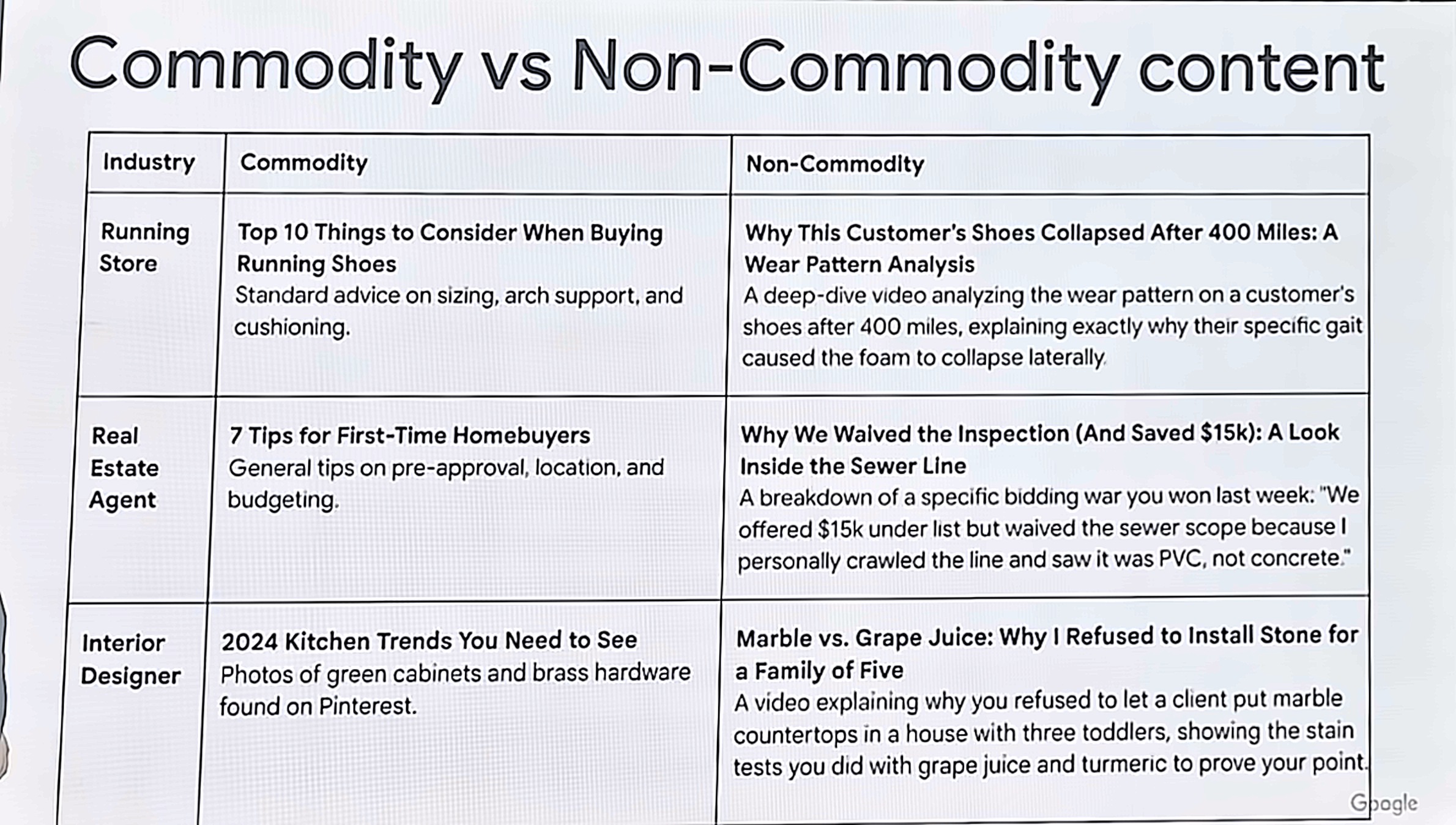
The slide I photographed four times compared commodity and non-commodity content. Danny Sullivan first used this framing at Search Central Live Toronto in April, and Martin brought the same slide to Cape Town. Commodity content is what anyone could write after ten minutes on Google. Non-commodity content comes from a specific case only you have seen.
The slide’s examples make the difference obvious:
- A running store can write “Top 10 things to consider when buying running shoes”. Or it can post a video showing why one customer’s shoes collapsed after 400 miles, and how their gait wore the foam down on one side.
- An estate agent can write “7 tips for first-time homebuyers”. Or they can explain why they waived an inspection and saved $15k: they crawled the sewer line themselves and saw it was PVC, not concrete.
- An interior designer can post “2024 kitchen trends you need to see”. Or they can film the grape juice and turmeric stain tests behind refusing marble countertops for a family with three toddlers.
Two of the three better examples are videos. That detail is easy to miss.
Martin’s own story landed harder than the slide. On a dive boat, he asked a tax advisor what the most interesting thing she’d worked on lately was. She said she had nothing interesting to share. Then it came out that she’d worked out how a company should tax stolen bitcoin that the Japanese police returned years after a hack. No AI tool can write that article, because nobody else has lived it.
The idea runs through the rest of the day. Martin said Google doesn’t care whether AI or a person wrote a page, only whether it’s useful. He described a test where readers picked out the AI-written version of one article 90% of the time, and the giveaway was that the human writer knew the subject. On Google’s closing “So what to do?” slide, the top line for AI Search was “Prioritize non-commodity content”.
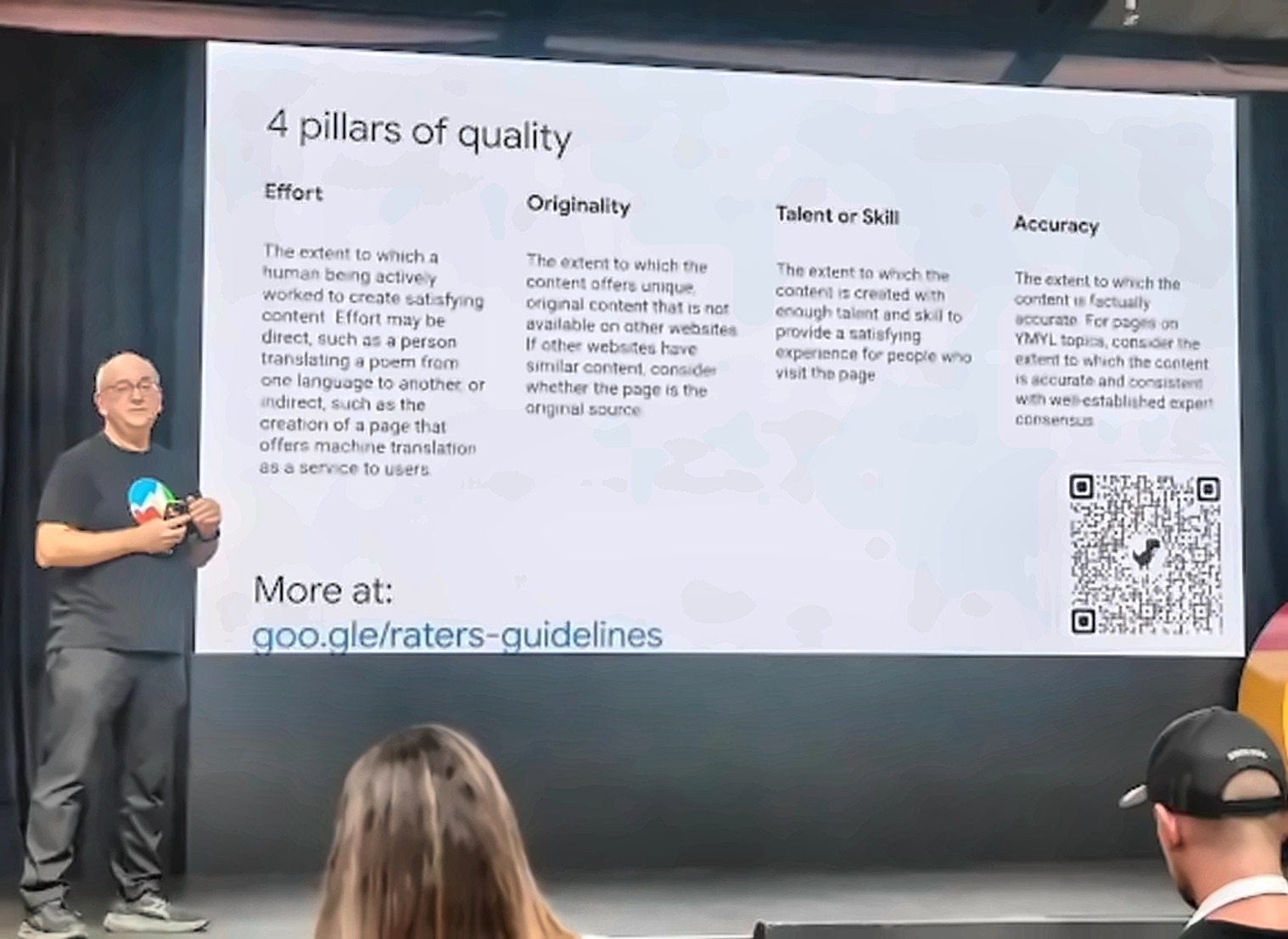
John’s slide on core updates listed Google’s four pillars of content quality: effort, originality, talent or skill, and accuracy. Google added them to its helpful content documentation in October, and the non-commodity examples above score on all four.
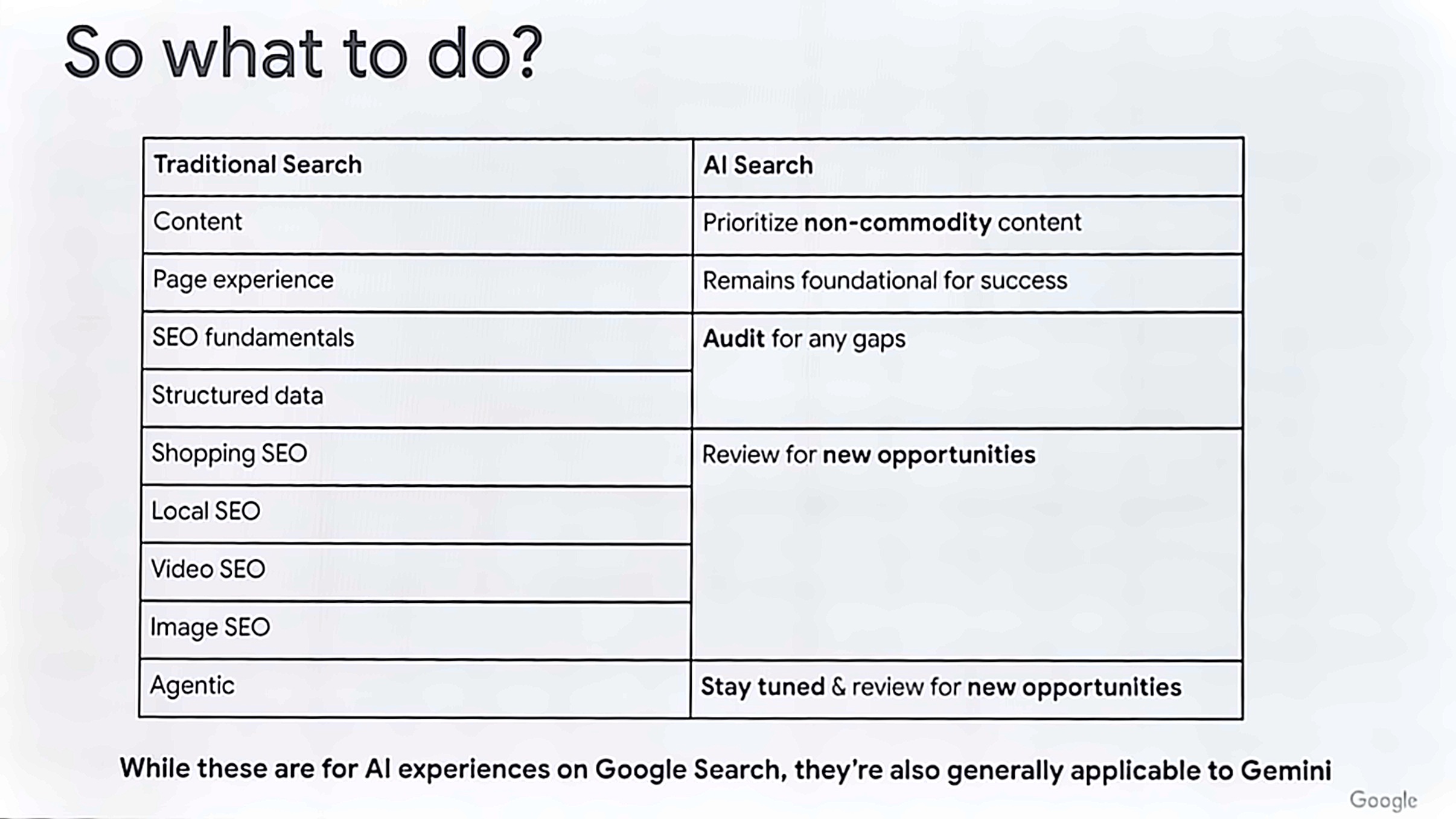
This also turned into the liveliest moment of the afternoon for me. During mythbusting, John and Martin asked whether content marketing is critical for small businesses. I argued for it, on the grounds that video helps small businesses get picked up by AI tools like Gemini. Their answer was that content marketing for its own sake isn’t critical. John’s example was a bakery writing about the history of bread, which nobody will find it for. But unique content, video included, is worth making. I’ll take that as a draw.
AI Overviews are built from search snippets
This was John’s most useful explanation of the day. When AI Overviews or AI Mode answer a question, Google runs a batch of related searches in the background, called the fan-out. It then reads the snippets on those results pages and writes the answer from them.
Google’s documentation already says nosnippet applies to AI Overviews and AI Mode. What I hadn’t heard put so plainly is why. The AI answer is assembled from the same snippet text you control with robots meta tags. That makes your snippet settings your AI visibility settings:
nosnippeton a page keeps it out of the AI answer as well as the normal snippet.data-nosnippeton a single element, like a price or a phone number, keeps that detail out of both, so people have to visit your page to get it.- None of this affects the Gemini app, which runs on separate settings.
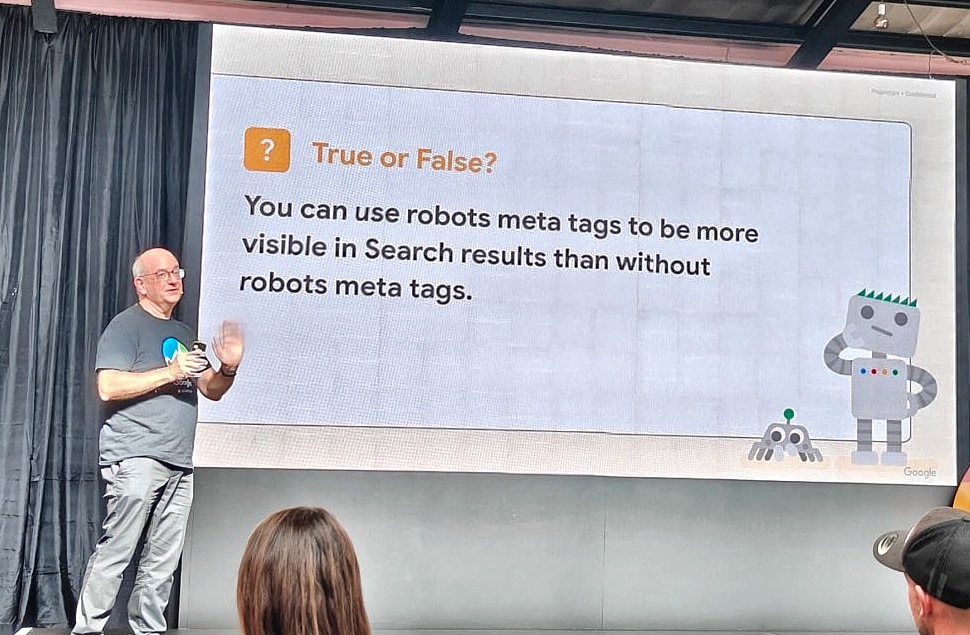
It works the other way too. During the controls session John asked the room whether robots meta tags can make you more visible. Most people assume they only restrict. He named max-snippet:-1, which lifts the snippet length limit, and max-image-preview:large, which allows big image previews, especially in Discover. Some WordPress SEO plugins already set both by default.
John didn’t claim a longer snippet gets you cited more in AI answers, and I won’t either. But if the snippet is what the AI reads, it’s worth testing. His suggestion was to try changes through Google Tag Manager first and watch click-through, because JavaScript can add robots meta tags (it just can’t remove a noindex). That’s the test I’m running on a few sites now.
Why Search Console’s generative AI report has no queries
Search Console’s generative AI report shows how often your pages appear in AI Overviews and AI Mode, but not which questions triggered them. Plenty of people have pointed out the gap. I wanted to know why, so I asked John directly: is it a technical limit or a privacy decision?
His answer was that it’s more of a privacy issue.
That matters more than it sounds. A technical gap gets fixed in a future release. A privacy decision probably doesn’t. It fits what John said on stage about long, unique queries, especially voice searches: Google only shows a query once enough people have searched exactly the same thing. He said Google needs to find ways to bubble that information up, but he doesn’t expect a magic list of every sentence people ask.
So if you want to know which prompts surface your brand in AI answers, don’t wait for Search Console. Track your own set of prompts with a dedicated tool, and treat Search Console’s AI impressions as a trend line rather than a keyword report.
Other things worth knowing
These came up in passing, and I haven’t seen most of them reported yet.
- John said the quality rater guidelines are getting an update soon. These are the guidelines Google’s raters use to judge whether proposed ranking changes make results better. I’ll be reading the new version for how much of the commodity thinking ends up in there.
- The Search Status Dashboard will carry advance warnings. John said Google plans to use it for proactive announcements when there’s something sites can do ahead of a change. Its RSS feed is worth piping into a Slack channel.
- Query groups may spread across Search Console. They currently sit in Search Console Insights, and John said Google is looking at bringing them into other reports.
- AI Mode agents will make attribution harder. John’s example: if someone asks AI Mode to tell them whenever their team wins, your match report could be shown to them a month after they asked.
- Core update recovery can take up to a year. John said a core update isn’t a penalty. It re-evaluates the whole site, and after real improvements the signals can take months or longer to catch up. More links, a domain move or technical fixes won’t fix quality on their own.
The mythbusting round also settled a few arguments quickly:
- Google doesn’t use llms.txt in Search (John).
- Structured data doesn’t help rankings. It makes pages eligible for rich results (John), and markup that contradicts the page is worse than none (Martin).
- Blocking Google-Extended doesn’t remove you from AI Overviews or AI Mode. It blocks AI training and grounding in the Gemini app (John).
- Ranking first doesn’t mean being cited first in an AI answer (John).
- Crawl budget only matters at around a million URLs (Martin).
- Negative SEO isn’t a real threat (Martin).
What I’m changing in my own work
These are the changes I’m making on client sites and in my own audits:
- Every content brief now asks the client for the specific case: the job that went wrong, the call a competitor wouldn’t make, the test they ran. Rewriting the same advice in better words won’t move a commodity page.
- AI Search audits now include a robots meta check. A stray nosnippet can explain missing AI citations, and a page blocked in robots.txt that also carries noindex never has its tag read.
- I’m testing
max-snippet:-1andmax-image-preview:largethrough Tag Manager on a few sites and watching click-through. - I’m tracking prompts directly instead of waiting for Search Console to show AI queries.
- Where a client sells something you can show, I’m recommending short videos and original photos over stock.
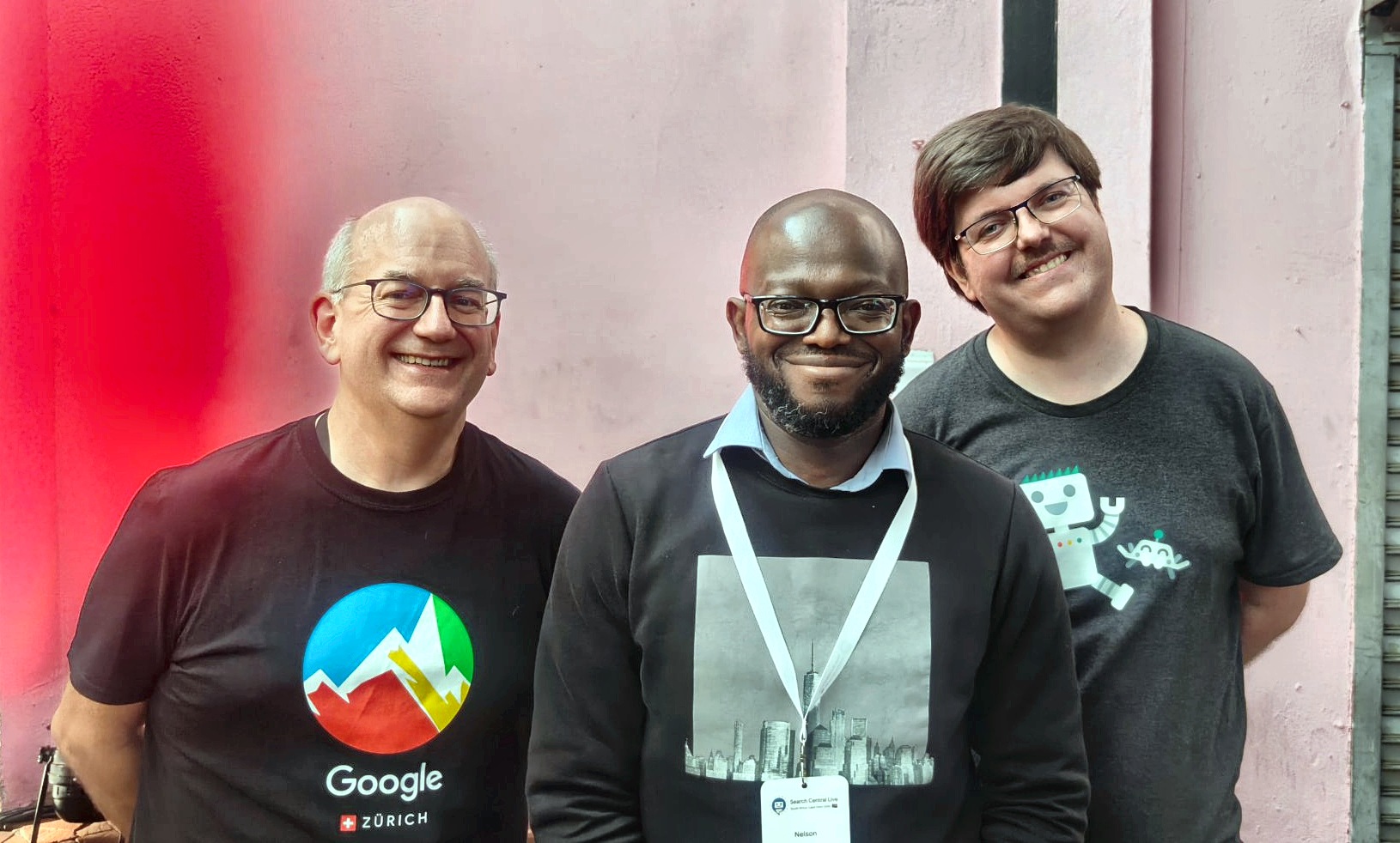
I flew in from Johannesburg for this, and John Mueller and Martin Splitt made the 4-hour round trip worth it. Thank you both, and thanks to the Google Search team for bringing Search Central Live to Cape Town for the first time.
If you take one thing from this post, take this: write the thing only you can write, then make sure Google is allowed to quote it.