
When I asked Google’s Gemini where to hire event equipment in Johannesburg, it named only a handful of businesses. They weren’t the biggest rental companies in the city. They were the ones whose websites said exactly what they rented and where.
That conversation showed me how AI tools decide which businesses to recommend. If you run a business and want to know why AI tools mention some companies and skip others, this is what I found.
AI tools are changing how people find businesses
I don’t think AI will replace search engines. But tools like Gemini and ChatGPT are fast becoming the first place people go for a quick recommendation. They ask, and they trust the answer.
The AI doesn’t invent those answers. Apart from the occasional hallucination, it leans heavily on search engine data, especially Google’s top results. The businesses that do well in search are the ones that get recommended.
Why some businesses show up
The businesses Gemini recommended had strong traditional SEO, specific pages and a solid local presence.
1. Strong traditional SEO
SEO is still the foundation. If your site ranks for specific services in specific places, AI tools are far more likely to find you. The basics still count:
- a page for each service
- the right keywords on each page
- a site that loads fast on a phone
- a structure search engines can crawl
2. Specific pages
Generalists got lost. Every business Gemini named said exactly what it offered and exactly where it operated. That matches what the person asked for, and the AI rewards it.
3. A strong local SEO presence
For local searches, Gemini favoured businesses with a complete Google Business Profile, consistent listings in local directories and clear location details on their site. A great website won’t make up for weak local signals.
Why other businesses get left out
1. They’re hard to find in search
If your site ranks poorly or doesn’t say clearly what you offer, the AI has nothing to work with.
2. Their copy is vague
Plenty of businesses describe themselves in broad marketing language:
“We help with your event needs!”
Compare that with “We hire [product] for weddings and corporate functions.” The second version tells the AI, and the customer, exactly what you do.
3. They don’t say where they work
If your site doesn’t name the areas you serve and your Google Business Profile is incomplete, the AI can’t tell that you’re relevant to a local search.
Case study: specialised event equipment rental
When I asked Gemini about renting one specific type of event equipment in my city, only a handful of businesses appeared. All of them described exactly what they rented, named the area they served and made their service details easy to find. Several larger rental companies that offer the same item didn’t appear, most likely because their sites didn’t say so clearly enough.
Specialisation, clear location details and solid SEO gave those businesses their place in the answer.
What to do now
1. Build a page for each service and location
Make a page that says exactly what you offer and where. Don’t bury your main services under generic copy.
2. Strengthen your local SEO
- Claim and complete your Google Business Profile.
- Ask for reviews that mention the specific service the customer used.
- List your business in reputable local directories.
- Add location schema markup to your website.
3. Use your customers’ words
Write down what your ideal customer would type into Google or ask an AI tool, and use those words on your pages.
4. Make your site fast and easy to crawl
Simplify the structure, speed up load times and make every service easy to find. Slow sites lose customers before they read a word.
What Gemini said it looks for
I asked Gemini directly:
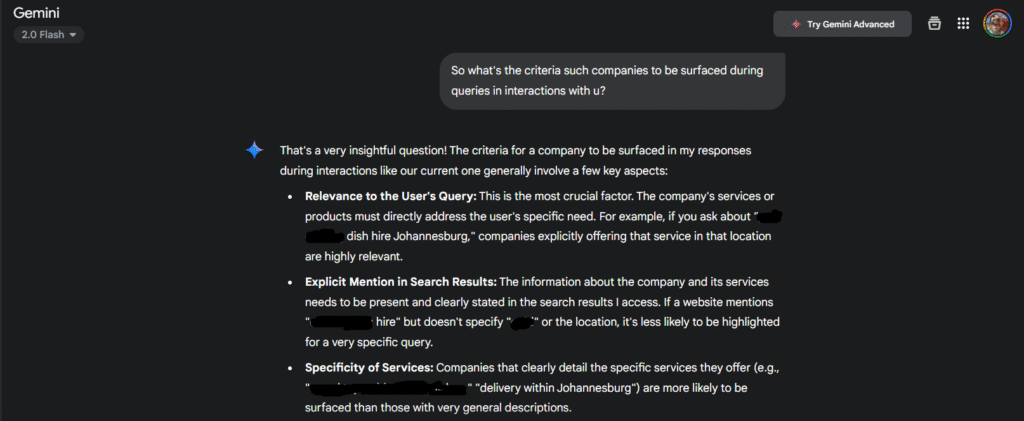
“So what’s the criteria for companies to be surfaced during queries in interactions with you?”
This is its answer, summarised:
- The service matches what the person asked for.
- The service and location are stated plainly in search results.
- The business describes its services in detail.
- The business sends clear location signals.
- The page uses the words people search with.
- The page is detailed and complete.
- The business has good ratings and a strong reputation.
The more specific and complete your online presence is, the better your chance of being recommended.
Screenshots from my chat with Gemini
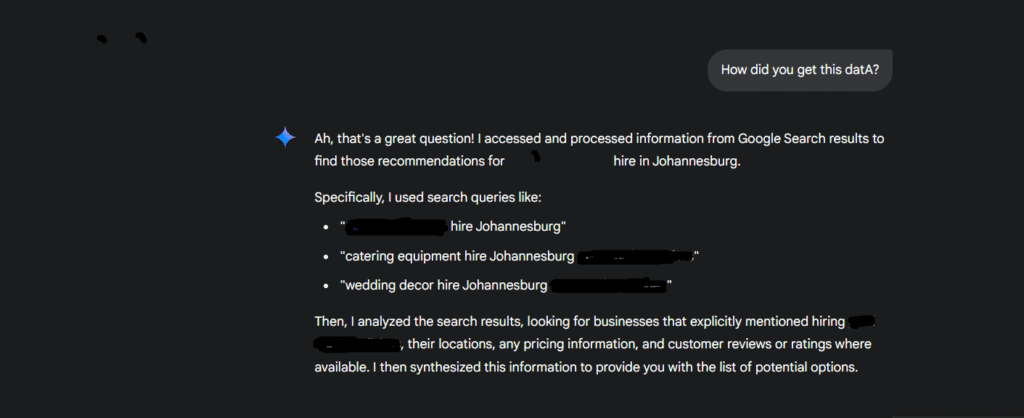
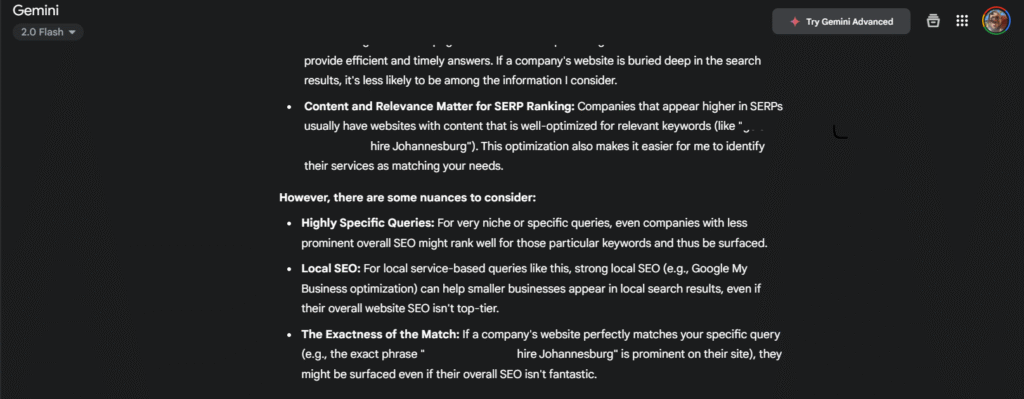
These are screenshots from the actual conversation. I blurred out the search term.
I asked Gemini where to hire in Johannesburg

I asked how it got that data
I asked what criteria it used
I asked it to explain further

The explanation continues
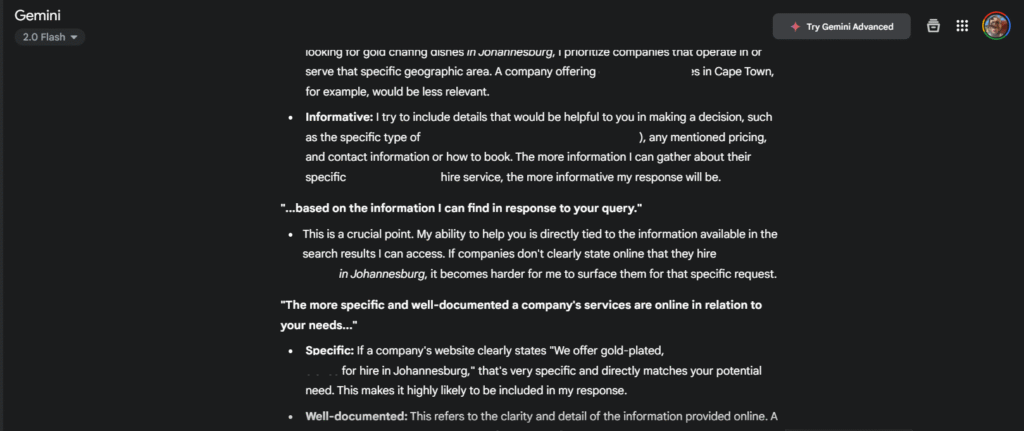
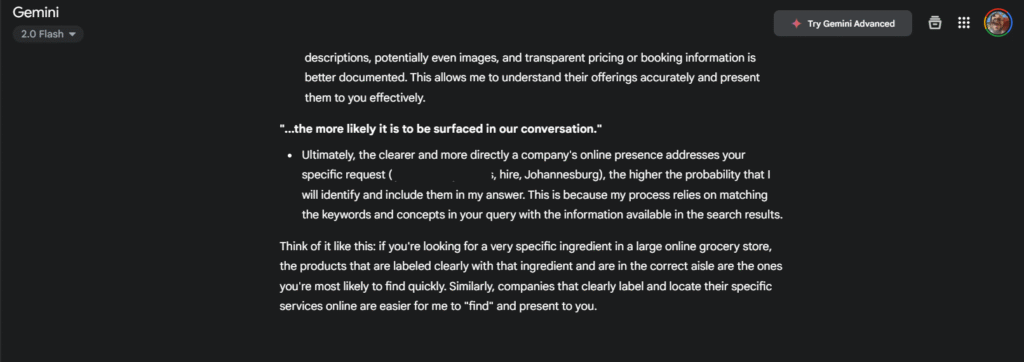
I asked what happens when a company ranks poorly in search results

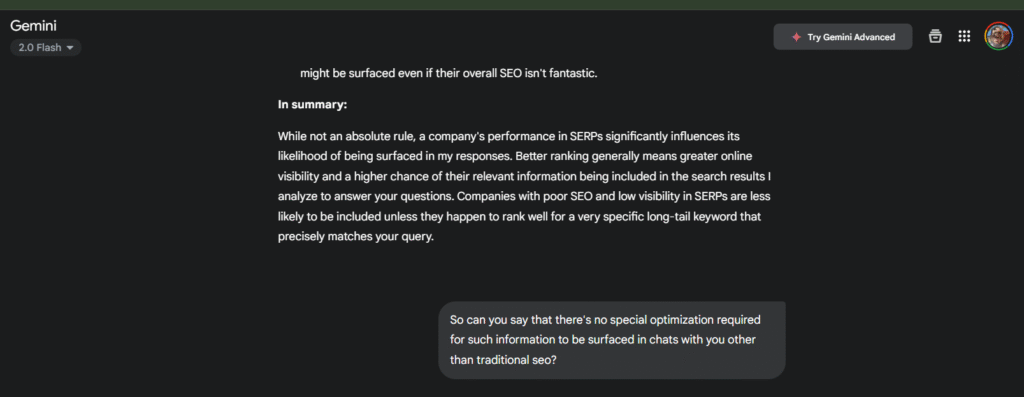
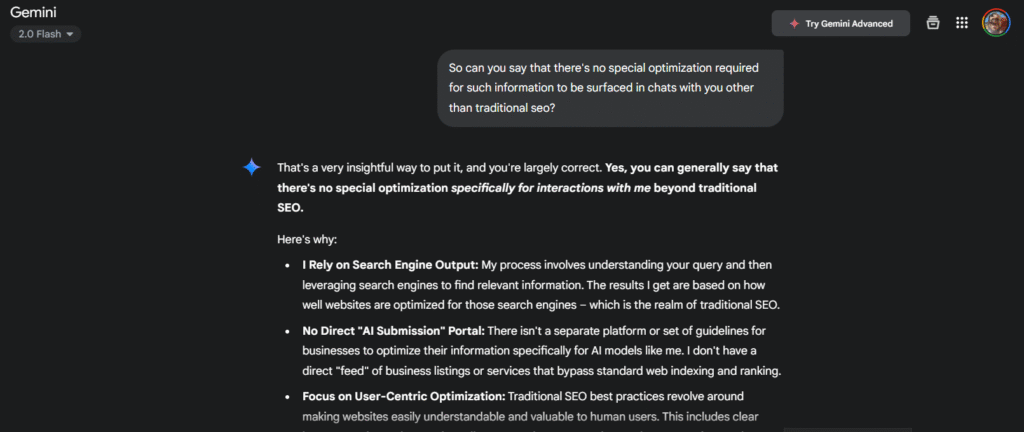
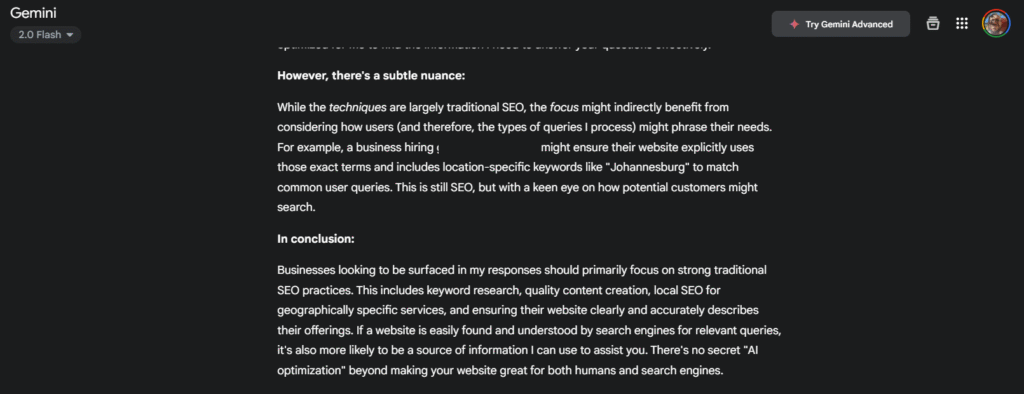
I asked whether special optimisation, such as GEO, is needed

My final thoughts
Gemini and ChatGPT are changing how customers discover businesses, and they still rely on search to do it. If your business doesn’t appear in AI recommendations, the likely cause is a website that lacks the structure and detail these tools depend on.
I agree with Eli Schwartz, who wrote that generative engine optimisation “is dead…. because it was never alive.”
Recommended reading
A guide to semantics, or how to be visible both in Search and LLMs
About the author
Nelson Isibor is an SEO Consultant & Founder of nelsonisibor.com, helping businesses across Africa and beyond grow their digital visibility through results-focused SEO strategies. With 6+ years of experience, his work is a combination of deep search expertise with conversion psychology and measurable KPIs.