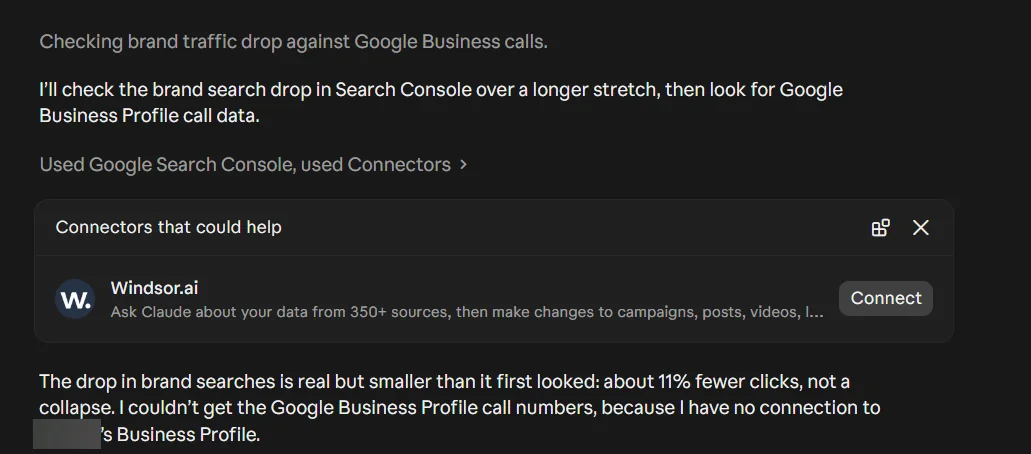
While working on a client account, I asked Claude to check a client’s drop in brand searches against their Google Business Profile calls. It pulled the Search Console data, confirmed the drop was smaller than it first looked, and then hit a wall. Search Console doesn’t hold calls made from the Business Profile, and Claude had no access to the profile.
So it suggested a tool I hadn’t asked for.
The card sat in the middle of the answer, headed “Connectors that could help”, with Windsor.ai and a Connect button. I hadn’t mentioned Windsor.ai, and it wasn’t connected to my account. Claude then gave me two ways forward: sign in to the Business Profile in the browser so it could read the Performance tab, or connect the suggested tool.
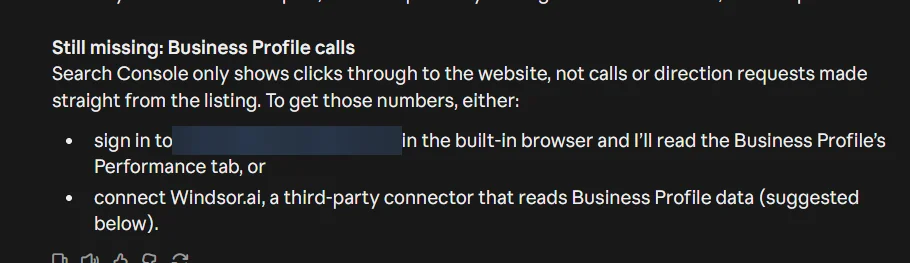
I’ve redacted the client’s name and my email. Nothing else is changed.
How Claude suggests connectors
Anthropic announced it in April. Its post on new connectors for everyday life says Claude now suggests the right app for what you’re doing, with examples like finding a reservation or identifying a flight. The directory has grown past 200 connectors since it launched in July 2025.
Most coverage framed it as a consumer feature: book a table, build a grocery cart. My example was neither. It was a work task, a data gap, and a suggested fix at the exact moment I needed one.
Why it matters if you sell software
So far, AI search has mostly meant one thing: getting your website cited in an answer. I’ve written about how one site earned 500,000 AI citations, and that work still matters.
This is different. The assistant isn’t quoting a page. It’s recommending a product, inside a task, to someone who has the problem right now. That’s closer to an app store than to a search result, and it happens without the person searching for anything.
Three things stand out to me:
- You can’t buy the spot. Anthropic says there are no paid placements or sponsored answers in Claude, and its help page on how Claude suggests connected apps says the order reflects what’s likely useful to you, not partnership arrangements. If that holds, this visibility is earned, not bought.
- You have to exist in the directory first. Claude can only suggest a connector that’s in the Claude connector directory. If your product has an API and your customers already ask AI tools about their data in it, a connector is the entry ticket.
- The description does the selling. The card showed one line of Windsor.ai’s description and a Connect button. That line is all the person sees before deciding. Write it around the jobs people actually ask for, not your feature list.
What nobody outside Anthropic knows is how Claude picks which connector to suggest. I’d be wary of anyone selling a method for it yet.
Why it matters if you’re the one clicking Connect
The suggestion came during client work. Connecting a third-party tool to a client’s Business Profile hands that tool access to the client’s data, under my account.
Before you connect anything to client data, check what access it asks for during sign-in, and whether you’d be comfortable explaining that access to the client. Anthropic’s own connector guidance says the same: review what the service is requesting, and disconnect what you no longer use.
For Search Console I built my own connector on Railway, so the data only passes through a server I control. That’s more work than a Connect button, and not everyone needs it. But the suggestion is an offer, not an instruction.
What I’d do now
If you run a SaaS product, check whether you’re in the Claude connector directory, and read your listing the way a stranger would in one line. If you’re a business owner, the same shift is happening one level down: assistants recommend businesses too, and I wrote a guide to claiming your business on ChatGPT in South Africa.
Improving your chances of being recommended by AI, whether it’s your site, your business or your product, is what my AI search work covers. Email me at nelson [@] nelsonisibor.com.